

I got similar questions from three different subscribers. They want to know which assets can be expected to do best through a looming financial crisis.
Question #1
I have some money in gold, and money in US/Int’l stocks via 2 US companies. But, if the USD goes under what happens to those companies? How can you hedge against that? — From S.
Question #2:
Very much enjoying the emails. How about one that looks into practical actions. How does gold compare with property investment? Non us/uk stocks? Cryptocurrencies? — From B.
Question #3:
Question. My current liquid holdings are:
- One third fixed income
- One third equities (mostly healthcare)
- One sixth gold
- One sixth cash
Would you change that ratio at all?” — From J.
All of these people were warned that they should never take financial advice from me. They understood that. // Do you understand that too? Please read this disclaimer. If that does not penetrate your skull, then this blog is not for you. //But there are people richer than me, with lots of credentials have wrestled with these question. They also give some principles for investing.
People increasingly want simplicity and confidence in investing, without devoting their life to financial research.
So simple, model portfolios are becoming more sought after. And people richer than me have created some very useful investing formulas I have seen recently.
Lots of model portfolios are popular these days:
- Ray Dalio’s All weather portfolio
- Dilbert cartoonist Scott Adams tried to put all the financial advice you’d ever need on to one page.
- Another, Exter’s Pyramid is a useful way to see how different assets perform in crises.
It ranks the major asset classes in order of size and risk:
- The riskiest assets are at the top of the pyramid. They tend to be very abstract and can be created in huge volumes.
- Safer assets are further down the pyramid, they are smaller in volume, being more difficult for the financial industry to create on their computer keyboards.
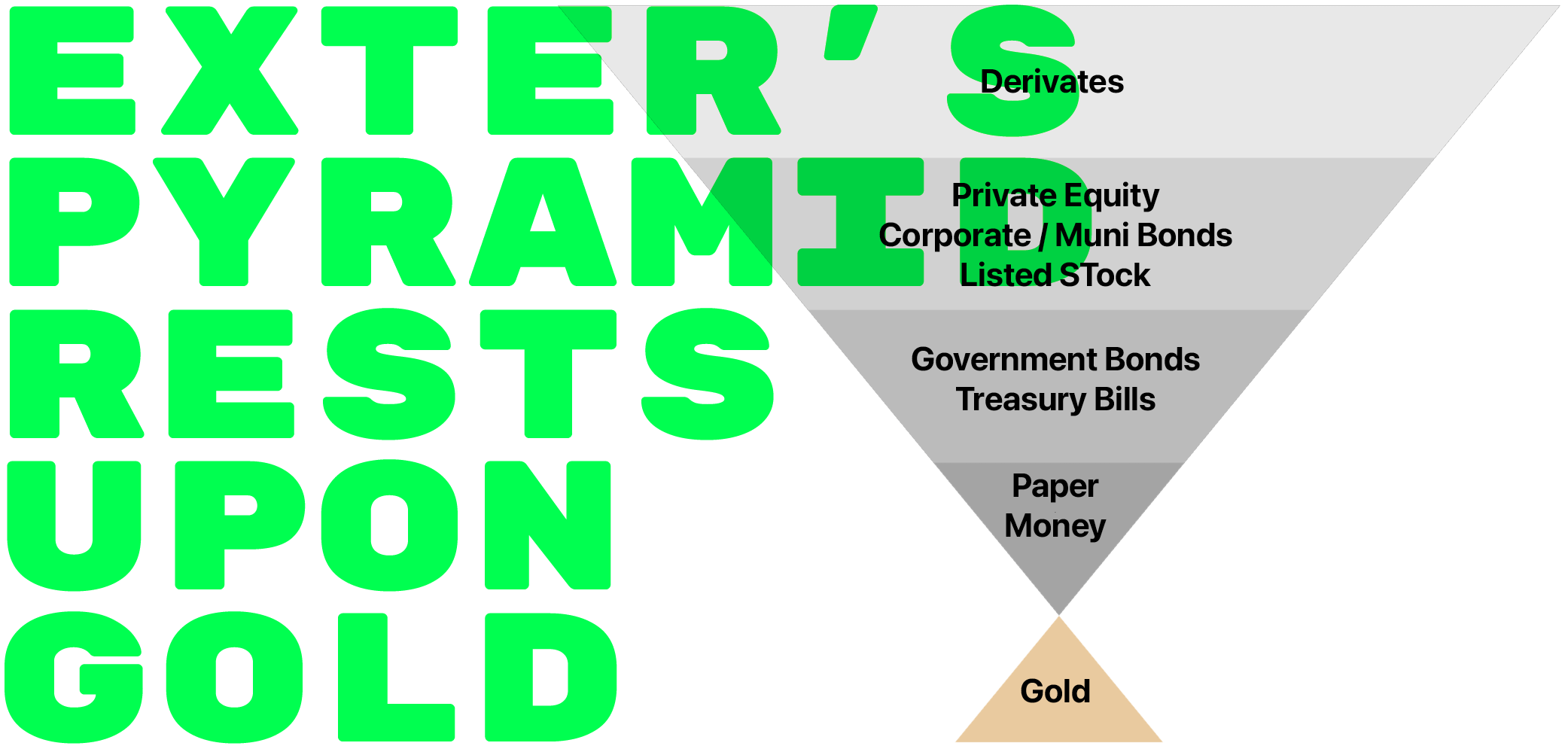
When markets panic, the assets at the top tend to collapse first. The destruction flows downwards, and where the cascade stops depends on how serious the financial crisis is.
Exter’s Pyramid is a theory and a model, so don’t treat it as scientific fact.
But it seems pretty accurate so far this year. According to Lyn Alden Schwartzer “asset classes crashed in price roughly in the order of Exter’s Pyramid … Commodities fell first, then stocks and corporate debt, then long-dated treasuries.”
What assets should we hold or avoid?
Six asset classes were mentioned in the questions I received: gold, stocks (US and international), US dollars/cash, real estate, and cryptocurrencies.
If we put them in order according to the pyramid, we get this (top to bottom, riskiest to least risky)*.
- Stocks
- Real Estate
- Digital cash (electronic currency in bank accounts)
- Physical cash (banknotes)
- Gold
(?. Cryptocurrency**)
What happens in a crisis?
Any asset is a hedge against what’s above it in the diagram, provided the crisis does not get bad enough.
The next question is how bad do we expect the next financial panic to be?
Could things get so bad, that gold becomes the only hedge against all the assets above it?
I’d say that is possible. And the Dutch central bank agrees, stating that if the financial system collapses, gold can be the basis for a reset.
In that scenario, the likely price of gold would be so ridiculously big that a small allocation, say 10%, could cover the losses on other assets.
Footnotes:
*I’m not discussing cryptocurrencies here because there it has no historical track record showing how they perform through several crises. I will write more about their prospects in the near future.
**There are many caveats. For example, in a crisis, the stock prices of some companies (food and healthcare etc.) do better than the stock of luxury consumer companies. There are also many other factors such as the location of the real estate, and currency risk when buying assets and so on etc.